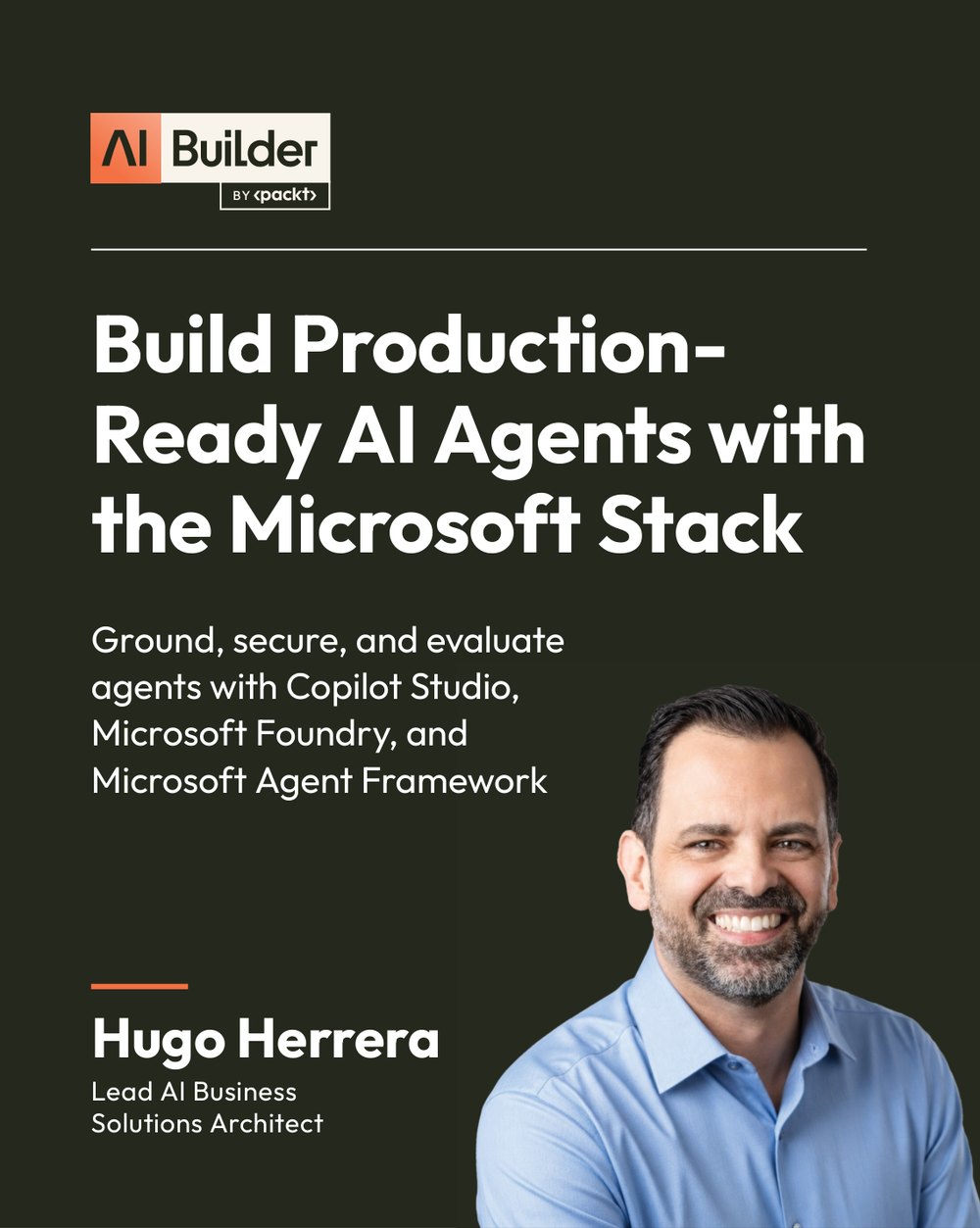
Production‑grade AI agents, designed and delivered at scale.
I help you find where AI agents add real value, then design and deliver them into production: agents that serve your customers, support your staff and take on routine work, governed and secure from day one.
85–89%Award-winning at SSEN Transmission. Efficiency savings from a feedback agent that won Bronze for Best Use of AI at the UK Customer Experience Awards 2024.- Copilot Studio
- Foundry
- Agent Framework
- M365 Copilot
AI agents that do real work, safely and in production.
I work with you to find the tasks where an agent will genuinely help, then design, build and launch it on the right Microsoft platform. I make sure it answers from your own data, only does what it should, is tested before every release, and hands over to a person when it matters.
How I go about it
We look at where you are today and pick the work where an agent adds real value.
Platform, data, security and approvals, agreed and drawn so everyone understands it.
I build with your team, with tests that run on every change.
Live with tracing, cost tracking and human sign-off, so it keeps earning its place.
Retrieve, augment, generate, review.
An AI feedback analysis architecture from my Handbook’s case study: every channel in, Azure OpenAI grounded on Dataverse, and a person in the loop for revisions.
Answers that come from your data.
Your agent answers from your own data and documents, shows where each answer came from, and is checked so that cited answers are also correct.
Narrow tools, clear limits.
I keep each agent to a small, clear set of actions, check who is asking before it acts, and threat-model the agent, the model and the network before it goes live.
Tested before every release.
I write the tests before the build and run them on every change, so a release only ships when it passes.
Every step traced, every token costed.
Every step is traced and every answer costed, so you can see what the agent did, and what each outcome cost.
A person decides where it matters.
Where a decision matters, the agent pauses for a person, keeps a full audit trail, then carries on safely.
Three Microsoft tiers. Use the lowest that fits.
- Copilot Studio. Grounded business agents, built fast and published with sign-in.
- Microsoft Foundry. Multimodal assessment with structured outputs, evaluation and tracing.
- Microsoft Agent Framework. Code-first, multi-agent workflows with shared state and durable approval.
Most use cases never need the top tier. Knowing which do is what my new book is about.
Build Production-Ready AI Agents89%
Efficiency gain reported by SSEN, with 90% accuracy against human review
A feedback agent that won Bronze for Best Use of AI.
- Azure OpenAI with RAG on Dynamics 365.
- Load-tested for 100,000 items a month, with human review of special cases.
- Governed by a DPIA, consent and threat models.
Reference builds you can see: Claims 365, the system my new book builds on all three tiers, and Project EVE.
More case studiesAn agent in production at SSEN, AI-run Playwright testing at a UK financial services organisation, and GitHub Copilot and Claude Code across a 15-person Microsoft team.
- Azure OpenAI and RAG
- Model evaluation: OpenAI, Claude, Gemini
- MCP
- Threat modelling
- DPIA
- Responsible AI
- Production hardening
Three ways to take an agent to production.
Agent readiness review
I test your current agents and data against what production needs, and write it up for your board. 2 to 3 weeks, at a fixed scope.
Ask about thisLead AI architect
I hold the agent architecture inside your team while you build and ship. On contract, typically 3 months and up.
Ask about thisAdvisory days
I review your agent designs and take the hard questions, booked by the day.
Ask about this